



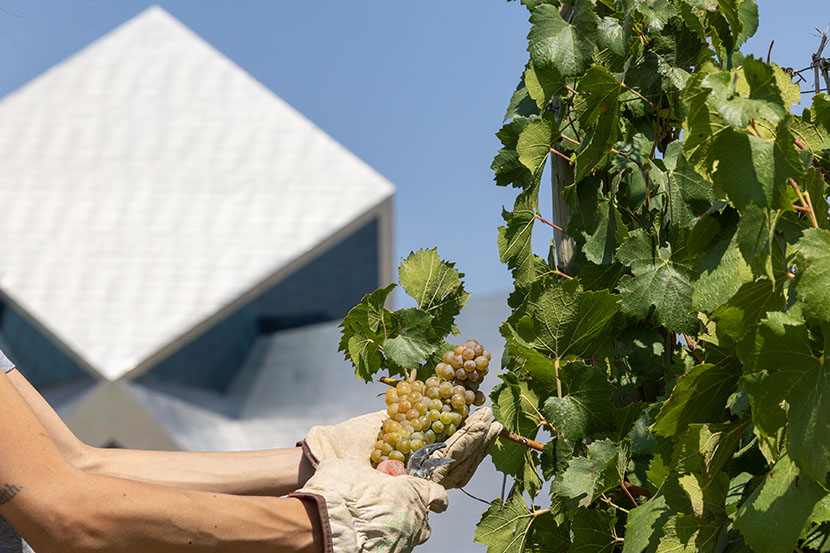
An exceptionally hot and dry summer has led us to bring forward the grape harvest to early August, whereas we would normally begin around the second half of the month. The earliest harvest in our history is characterised by a smaller crop, but also by outstanding grape health. The heavy rainfall recorded during winter and spring has allowed our vineyards to enter the summer with sufficient water reserves.
In this regard, our winemaker, José Javier Echandi, explains: “Climate change forces us to face unfamiliar conditions every year, so it is essential to anticipate them and adapt accordingly.”
To achieve outstanding quality even in years like this, we apply measures such as careful canopy management, which protects the grapes from direct sun exposure, and we remove the cover crop to avoid competition for water between the vegetation and the vines.
In addition, we cultivate our vineyards in some of the northernmost and highest-altitude areas of the Somontano PDO, including our Güel vineyard, located between 750 and 1,000 metres above sea level.
A Sustainable Night Harvest
The 2026 harvest began before dawn, taking advantage of the coolest hours of the day. The first variety to be harvested was Gewürztraminer, followed later this week by Chardonnay and Pinot Noir.
Next, we will harvest varieties such as Sauvignon Blanc, Merlot, Syrah and our high-altitude Garnacha Blanca. The harvest will conclude in early October with old-vine Garnacha from the Calatayud PDO.
Overall, the harvest is expected to last around 50 days. As in previous years, we will rely on state-of-the-art technology to produce wines of the highest quality.
We also continue working to make each harvest more sustainable. Harvesting at night significantly reduces the energy required to cool the grapes before maceration.
This commitment is reinforced by our joining International Wineries for Climate Action (IWCA) one year ago, a leading international organisation that certifies wineries committed to measuring, reducing and sharing decarbonisation efforts.
This July, we underwent a new audit with the aim of achieving Silver status, a certification that confirms the winery not only measures its carbon footprint but also implements continuous, independently verified reductions in greenhouse gas emissions.
“Over the past few years, we have introduced improvements and optimised our processes, enabling us to become virtually self-sufficient. Today, two-thirds of the energy we consume is generated by photovoltaic panels installed at the winery. We have also reduced the weight of our bottles by using less glass, lowered our water consumption, and implemented measures to make our logistics chain more efficient. For us, taking another step forward in the IWCA sustainability certification reaffirms our commitment to the planet,” says our Marketing Director, Diego Mur.


